


What Is Contextual Intelligence?
Key Takeaways
- Contextual intelligence is a data system capability that enables accurate reasoning by integrating five dimensions of context: semantic meaning, relational connections, temporal history, behavioral patterns, and operational constraints.
- Lack of contextual intelligence is one of the primary reasons AI projects fail. Gartner predicts that through 2026, organizations will abandon 60% of AI projects unsupported by AI-ready data. IBM, Confluent, and Atlan each independently named this failure mode in 2025 and 2026.
- The term is used differently across vendor categories because each platform type is strongest at different context dimensions, which explains the apparent contradictions in how vendors define it.
- In high-stakes use cases such as fraud detection, claims investigation, AML compliance, and national security, missing context has direct, measurable costs in false positive rates, investigation time, and regulatory exposure.
- Contextual intelligence is not the same as business intelligence, which reports on what happened, or decision intelligence, which recommends what to do next. It is the prerequisite for both.
- Semantic and relational context are most effectively encoded at data ingestion. Behavioral and temporal context require ongoing accumulation. All five must be maintained continuously for reasoning to remain accurate.
What is contextual intelligence in simple terms?
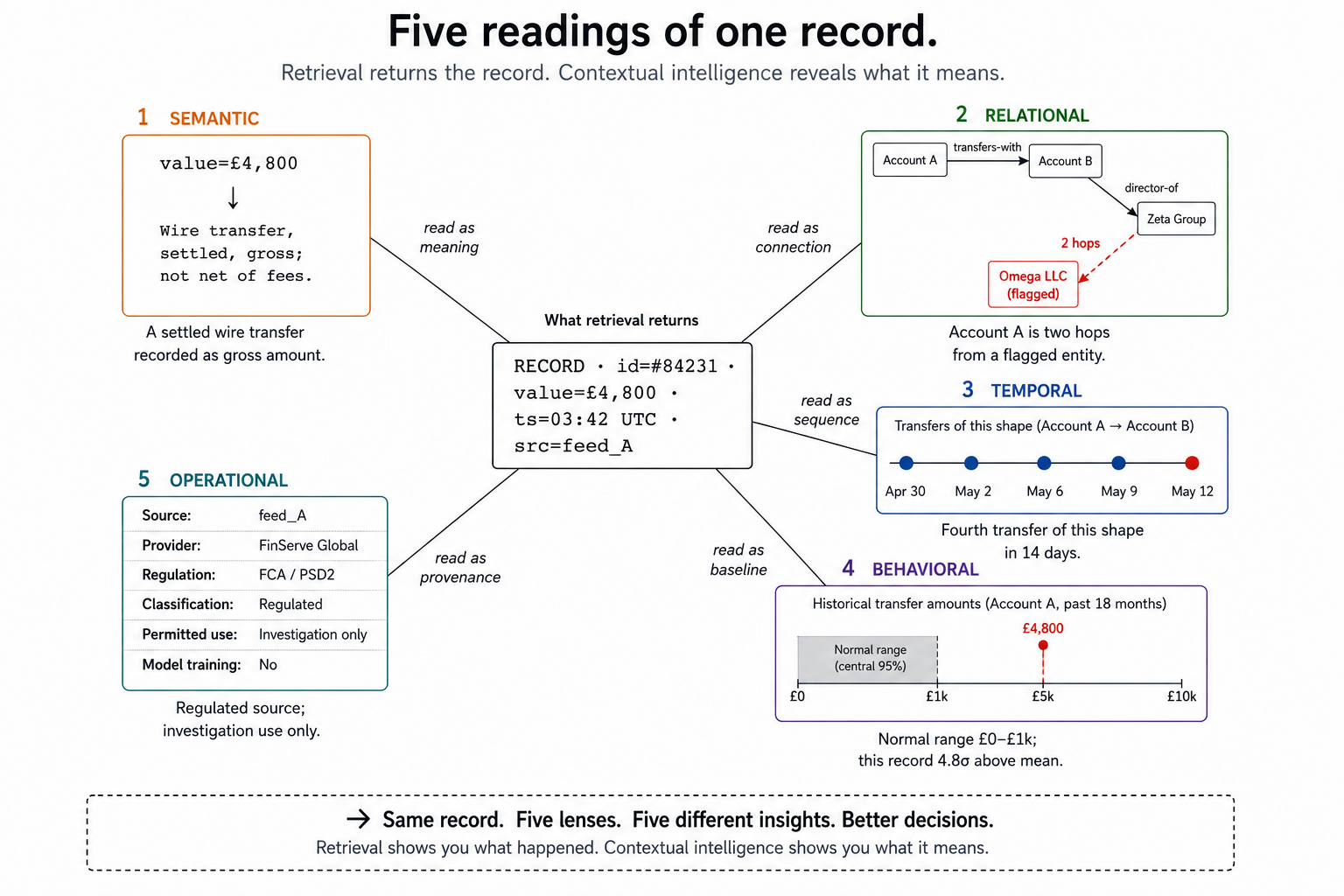
Contextual intelligence is a data system's ability to interpret information accurately, not just retrieve it. It does this by integrating five dimensions of context:
- Semantic. What data values actually mean.
- Relational. Who and what is connected.
- Temporal. What a sequence of events reveals.
- Behavioral. What normal behavior looks like for a given entity.
- Operational. Where data came from and what rules govern its use.
Without all five, a system can pull data but cannot reliably tell you what that data means in the situation you are looking at.
How Ally Built a Modern Fraud Intelligence Platform
Learn how Ally applied graph analytics and contextual investigation tools to uncover complex fraud networks and strengthen fraud prevention.
Read Case Study
The term has its roots in cognitive psychology and leadership research, where it describes a person's ability to read and respond to complex environments. In enterprise data and AI, the concept maps to the system level: can your platform interpret a data point in its full context, or is it reading that point in isolation?
The gap between having data and understanding it is where decisions break down. A system that retrieves a transaction record is doing something fundamentally different from a system that can tell you whether that transaction fits the customer's established behavioral profile, who else is connected to that customer, what happened in the weeks before, and what regulatory constraints apply. The first system has data. The second has context.
How does Contextual Intelligence compare to Decision Intelligence?
Decision intelligence is only as good as the contextual intelligence underneath it. Gartner's 2026 Intelligence Capabilities Framework codifies the dependency, placing the Intelligence layer (analytics, models, AI workflows) directly on top of the Context layer (knowledge graphs, ontology, semantic reasoning). But contextual intelligence and decision intelligence answer different questions. One tells you what's happening. The other tells you what to do about it.
To confuse things further. Some vendors have started using the term contextual decision intelligence to describe systems that combine both layers in a single workflow.
| Decision Intelligence | Contextual Intelligence | |
|---|---|---|
| What it answers | "What should we do?" | "What's actually going on?" |
| What it gives you | A recommendation or action | A picture of the situation |
| What it assumes is already done | Understanding the situation | Collecting the data |
| Best for | Repeatable, optimizable decisions | Investigations, fraud, AML, complex AI reasoning |
| What goes wrong without it | Inconsistent decisions | Confident answers that turn out wrong |
How does contextual intelligence work?
Contextual intelligence is built from five layers. Each one adds something a system cannot reason without. Together they produce a complete picture of what a data point means in its actual situation.
Semantic context
is about meaning. A field labeled "revenue" might mean recognized revenue under a specific accounting standard, a provisional forecast, or a gross figure before deductions. Those are three different things. A system without semantic context, encoded through ontologies, data models, and agreed definitions, treats the label as the meaning. It is not.
Relational context
is about connections. Two accounts running a series of transfers may look unremarkable on their own. The picture changes when you discover both accounts share a registered director and a prior history of activity with a third account under sanctions review. Relational context requires entity resolution, the process of identifying that records across different systems refer to the same real-world entity, and graph structures to map and query those connections.
Temporal context
is about sequence. Timestamps tell you when something happened. Temporal context tells you what a sequence of events means. Transactions that look ordinary in isolation can indicate layering, structuring, or coordinated fraud when read in order, over time. A system without temporal context is reading snapshots. It is missing the story.
Behavioral context
covers two dimensions of behavior. The first is what is normal for a specific entity. A £8,000 wire transfer is unremarkable for a logistics company with established supplier relationships. The same transfer from a recently opened retail account is a different matter. Behavioral baselines built from historical data are how the system distinguishes routine from suspicious.
The second is the user's behavior: what they are trying to do with the data, expressed as usage and intent. In agent-based applications, this dimension arrives through the system prompt, where the developer encodes what the user is trying to accomplish, and the agent reconciles that intent with each user request before retrieving data. Agent platforms now show this work explicitly with status messages like "refining intent," shown while the agent matches the system prompt to the question being asked. The same data, called for two different purposes, requires two different views.
Operational context
is about provenance and rules. Where did this data come from? Who is allowed to use it? What governance constraints apply? Source, lineage, and classification determine whether a data point can be used in a given analysis at all, and how much confidence the system should place in it.
Miss any one of these layers and you get a specific class of error. No relational context means you can define what an entity is but not who it is connected to. No temporal context means you can spot a deviation but not whether it started last week or has been building for six months. Each gap has consequences.
Why do data systems fail without contextual intelligence?
Most enterprise data systems handle context partially. A data warehouse knows where data came from (operational context) and can carry some definition of what it means (semantic context). What it does not do is track who is connected to whom, what a sequence of events reveals over time, or what normal behavior looks like for a specific entity. It can tell you what is stored. It cannot tell you what it means.
For most of the last thirty years, enterprises compensated for missing context with people. Analysts, investigators, operations teams, and domain experts assembled meaning manually across systems. The architecture was designed for reporting known questions, not exploring unknown ones. That trade-off was acceptable when workloads moved at human speed and decisions remained bounded by predefined reports, workflows, and business processes. The cost was friction, delay, and labor; but the systems still functioned.
AI changes the equation because the human assembler disappears from the loop. Models can retrieve data instantly, but retrieval is not understanding. Without machine-readable context (relationships, behavioral norms, temporal patterns, operational meaning) AI systems inherit the same fragmentation humans previously compensated for manually. Contextual intelligence is the grounding layer for explainable AI: the data substrate that gives an LLM the typed, traceable, multi-hop facts it needs to answer questions a regulator can audit.
At scale, that missing meaning is why AI projects fail. Not bad LLMs. Not insufficient compute. Missing context. Gartner predicts that through 2026, organizations will abandon 60% of AI projects unsupported by AI-ready data. IBM, Confluent, and Atlan each independently named this failure mode in 2025 and 2026.234 IBM described the problem as "the gap between what a system can access and what it needs to understand," a failure mode that persists regardless of how capable the underlying model is.
The cost is visible in financial crime compliance. SAR filings have increased more than 40% over the last five years. A significant part of that workload is manual data contextualization: pulling together transaction records, entity relationships, behavioral history, and prior alerts from separate systems to build a picture that the systems themselves cannot produce. The Bank Policy Institute's 2024 industry survey of 15 large banks found that the actual time to file a single SAR averages 21.41 hours, more than 10x the Financial Crimes Enforcemant Network (FinCEN) official estimate of 1.98 hours. UK financial institutions alone spend an estimated £34.2 billion a year on financial crime compliance labor. Contextual intelligence can dramatically reduce these costs. In certain transaction monitoring environments, AI with full contextual integration has demonstrated false positive reductions of up to 40%.
The pattern holds across industries. A system that cannot reason about what its data means will produce outputs that are technically accurate for the slice of reality it can see but wrong for the actual decision being made.
What are the challenges of contextual intelligence at enterprise scale?
Contextual intelligence is achievable, but maintaining all five layers simultaneously at enterprise scale has real technical and organizational costs.
Data volumes grow faster than ontologies can be updated. The result is semantic drift: the same term picks up different definitions in different systems and teams, and nothing flags the inconsistency.
Entity resolution at scale means making precision-versus-recall trade-offs across billions of records. Get it wrong in either direction and the error compounds. Incorrectly merged records and incorrectly separated records both produce wrong relationship maps, and everything built on top of those maps inherits the error.
Temporal context is particularly fragile. Ordered event history has to survive data migrations, archiving processes, and system updates, all of which can reorder or truncate that history in ways that silently invalidate the behavioral baselines built from it.
Regulation adds pressure. AI governance has become inseparable from contextual intelligence: in a growing number of jurisdictions, AML, KYC, and fraud frameworks require that AI-assisted decisions be explainable, traceable back through the context that produced them, not only the model that generated them. A system that assembles context at query time rather than encoding it continuously cannot reliably produce that audit trail. The context that existed when the decision was made may simply be gone.
Learn more about contextual intelligence from DataWalk
Entity Resolution Software: How DataWalk's graph and AI platform resolves entities across siloed systems to build the relational context that accurate investigation and compliance decisions require.
Knowledge Graph Software: DataWalk's unified knowledge graph product, which organizes enterprise data around business objects to deliver the semantic, relational, and temporal context that investigation and compliance decisions depend on.
Reducing AML False Positives Without Replacing Systems: How applying contextual intelligence at the point of AML investigation reduces false positive alert volumes without requiring a system replacement program.
Detect Hidden Threats: How a Unified Knowledge Graph Overcomes Data Silos: How a unified knowledge graph closes the context gap by connecting internal and external data sources into a single investigative environment.


Dr. Michael O’Donnell is a Senior Analyst covering data management strategy, with a particular interest in the gap between data and business value. He tracks the full stack (converged platforms, semantic enrichment, knowledge graphs, data products) is interested in what each gets right, where it stops short, and what that pattern keeps revealing. His measure is simple: can the person who needs the answer get it without an engineer in the middle.
ContactTable of contents
- Key Takeaways
- What is contextual intelligence in simple terms?
- How does Contextual Intelligence compare to Decision Intelligence?
- How does contextual intelligence work?
- Why do data systems fail without contextual intelligence?
- What are the challenges of contextual intelligence at enterprise scale?
- Learn more about contextual intelligence from DataWalk
FAQ
Join the next generation of data-driven investigations:
Discover how your team can turn complexity into clarity fast.

Solutions
Product
Partners
Company
Resources
Quick Links