
Give AI findings it can defend.
AI agents can explore questions nobody anticipated. But they shouldn't have to work everything out. Let DataWalk handle what can be established through computation, so agents spend their effort on judgement, not arithmetic.
DataWalk provides connected business context and deterministic analytical capabilities, delivering findings grounded in enterprise data, with the evidence attached.
The problem is AI sounds right either way.
Some work only needs direction. Other work demands a precise and repeatable answer.
Directional work
When good enough moves you forward.
- Summarise a report
- Explore an idea
- Find a promising lead
A useful direction can still be valuable.
Exacting work
When good enough isn't enough.
- How far does the exposure reach?
- Who else is connected?
- Which decision can we defend?
When you're accountable for the outcome, precision and repeatability aren't optional.
Beyond retrieval. Into computation.
Resolve identities, trace relationships, and run the numbers in one place. DataWalk combines entity resolution, search, graph analysis, and relational analytics on the same data under one set of permissions.
The semantic layer defines and calculates metrics. Your team has to build and maintain the logic that identifies which records refer to the same entity and how those entities are related.
Your matching tool resolves the records. The graph engine finds the connections. Your reporting engine calculates the result. Your team moves data between all three.
DataWalk resolves identities, follows relationships, and runs calculations on the same data under one set of permissions. The agent gets a computed finding and the records and relationships that show how DataWalk arrived at it.
Context, resolved through computation.
Deterministic. Not generated.
DataWalk applies defined rules, graph operations and calculations to connected enterprise data to establish findings that AI agents can rely on. Rather than asking an LLM to infer facts from retrieved information, the platform performs the analytical work and returns structured results with supporting evidence.
- Rules: Apply defined business logic consistently across connected entities and relationships.
- Graph inference: Derive findings from relationships, paths and network structures.
- Population analysis: Calculate aggregates, scores and measures across large connected populations.
- Repeatability: Produce consistent analytical results from the same data, definitions and operations.
- Evidence: Preserve the underlying records and relationships supporting the findings.
Enterprise-scale data. Connected by business meaning.
DataWalk materializes data from multiple sources into an enterprise knowledge graph. Its ontology defines the business entities, attributes and relationships that agents can query and analyse.
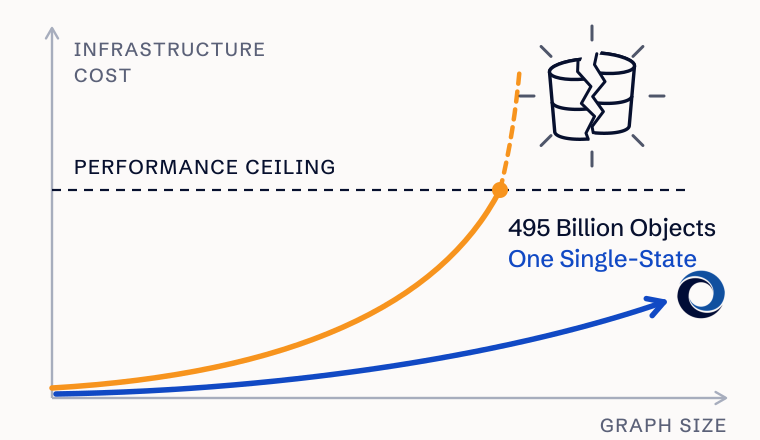
- Enterprise scale: Support hundreds of billions of objects in a distributed knowledge graph.
- Ontology-first: Model business entities and relationships independently of source-system schemas.
- Entity resolution: Identify records referring to the same real-world person, company or asset.
- Connected data: Relationships are stored and kept current as data, so they’re not re-derived for every query.
- Persistent knowledge: Share established identities, relationships and definitions across users, applications and agents.
The agent asks. DataWalk computes.
DataWalk supports iterative, agent-directed analysis. DataWalk executes the data-intensive work (traversing relationships, applying rules and calculating results) and returns focused findings for the agent to interpret or investigate further.
- MCP Server: Exposes DataWalk’s analytical capabilities as standardized agent tools.
- Driver-executor architecture: Agents plan and iterate; DataWalk executes the data-intensive operations.
- User permissions and audit: Queries run under the requesting user’s DataWalk permissions. DataWalk logs tool calls, data access, and changes.
Follow the question. Wherever it leads.
DataWalk lets agents explore connected enterprise data without knowing every path or relationship in advance. An agent can start with a search, ask DataWalk to follow the relationships from those results, and get a calculation across the entities it finds. DataWalk runs all three steps on the same data, without passing results between engines.
- Search: Find the entities, records and populations relevant to a question.
- Graph: Follow relationships, discover paths and explore connections without predefined traversal limits.
- Relational: Filter, group, aggregate and calculate across connected populations.
- Scale: Analyse complex networks containing billions of objects and hundreds of billions of relationships.
Complex questions don't get smaller for AI.
An agent's question can span an entire population and run many relationships deep. A reliable answer depends on executing that analysis across all of the relevant data. DataWalk carries out the work on the agent's behalf, at enterprise scale.
Built for petabyte-scale ambition. Proven at enterprise scale.
Frequently asked questions
Find your answer
Does DataWalk provide the AI model?
How do AI agents connect to DataWalk?
What’s the difference between context retrieval and context resolution?
What does deterministic computation mean?
Does DataWalk need to copy our enterprise data?
How are permissions enforced when an agent uses DataWalk?
How is DataWalk different from RAG or a semantic layer?
Is the Context Resolution Framework available today?
What does your AI need to understand?
Bring us the question, the data and the analytical challenge. We'll explore how DataWalk can support the workload.