
Connect your data. Analyze without limits.
More than a connected data model. A platform to analyze, govern and operate it at enterprise scale.
DataWalk brings people, organizations, transactions and other entities together in an enterprise knowledge graph. Resolve identities, uncover connections across multiple sources and analyze billions of objects without predefined paths. Built for the scale, performance and changing demands of enterprise operations.
Every fix adds another dependency.
A new ‘question’ or ad-hoc analysis is generally unplanned. It can also mean another extract, mapping or pipeline. When a source changes, teams may have to make the same fix in several places.
DataWalk gives teams a shared business ontology they can reuse as new questions and sources come up.
Find connections between groups of accounts.
Start with a search or a list of accounts. Choose the group you want to reach, then follow payments through intermediaries within the dates that matter. Open the payment records behind a connection to see why it qualifies.
| From | To | Booked | Source record |
|---|---|---|---|
| A-04 | B-17 | 12 Feb 2026 | PAY-041 |
| B-17 | C-09 | 13 Feb 2026 | PAY-117 |
| C-09 | D-22 | 13 Feb 2026 | PAY-152 |
| D-22 | E-10 | 14 Feb 2026 | PAY-176 |
| E-10 | T-01 | 14 Feb 2026 | PAY-209 |
01 · Select the populations
Start with many accounts. Define the target group you want to reach.
02 · Follow qualifying routes
Follow directed payments through intermediaries within the chosen dates.
03 · Inspect the evidence
Open the payment records that explain a selected connection.
| From | To | Booked | Source record |
|---|---|---|---|
| A-04 | B-17 | 12 Feb 2026 | PAY-041 |
| B-17 | C-09 | 13 Feb 2026 | PAY-117 |
| C-09 | D-22 | 13 Feb 2026 | PAY-152 |
| D-22 | E-10 | 14 Feb 2026 | PAY-176 |
| E-10 | T-01 | 14 Feb 2026 | PAY-209 |
Deep traversal. Answers without the wait.
Complex investigations shouldn't mean long-running queries. Follow connections through millions of records, change direction and explore another path while the analysis is still fresh in your mind.
Explore complex relationships across massive datasets, with results fast enough to keep pace with your thought.
In a 20 TB benchmark, a directed, date-filtered traversal in just 0.57 seconds reaching 5.37 million accounts.
DataWalk benchmark. Median of 10 runs with warm storage and one user. The test counted accounts reached from one starting account. It did not list paths or retrieve payment records.
Add data sources faster.
Map a new source to the people, accounts, payments and companies you already work with. For standard mappings, DataWalk handles the processing without custom pipeline code. Sources that need extra preparation may require transformation.
- Declarative field mapping
- Reuse the existing ontology
- No per-source pipeline code
- Consistent, connected data
Existing business ontology
customer_id→Person · IDfull_name→Person · nameaccount_no→Account · numberamount→Payment · amountbooking_date→Payment · bookedreg_number→Company · registration no.company_name→Company · nameThe connection is data, too.
Most systems store transactions and leave you to reconstruct their relationships. DataWalk models both, so you can investigate how records connect without predefined paths.
Filter transactions. Follow relationships. Trace findings to their source.
- From / to
- Account A→Account B
- Amount
- EUR 12,450
- Booked
- 11 March 2026
- Source record
- PAY-01
- From / to
- Account C→Account D
- Amount
- EUR 8,230
- Booked
- 2 April 2026
- Source record
- PAY-02
Two payments can share a device even when they involve different accounts. DataWalk records that link so you can filter by it and trace it back to the source records.
Model the business once. Ask more of it.
Define the people, organizations, relationships and calculations your business uses. DataWalk maps and imports source data into that shared ontology and refreshes configured dependencies as information changes. Analysts, applications and AI can use the same governed data. The search index lives inside the DataWalk database, so you can find a company, follow its ownership links and narrow the results in the same analysis. There's no separate search service to keep in sync.
Hover or tap to explore
Built for production. Not just proof of concept.
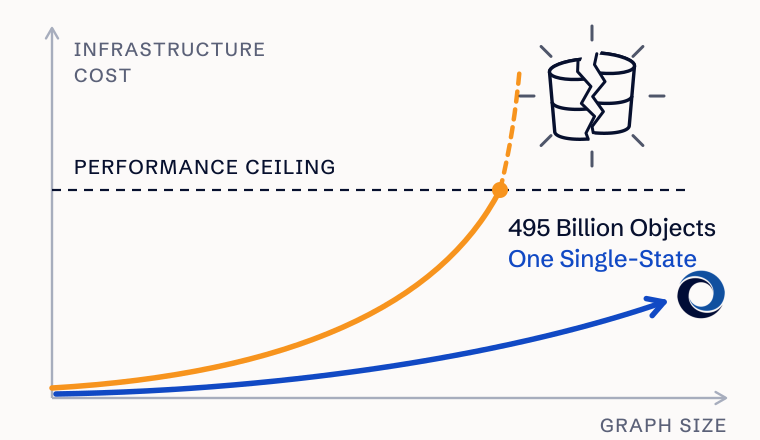
An enterprise knowledge graph must support demanding analysis while keeping shared data secure, traceable and current. DataWalk brings those capabilities together so the graph can serve more teams, more use cases and more data.
Security and governance.
Permissions govern access to records, attributes and connections during analysis, including path finding. Analysts, applications and AI agents work within their authorized access, with activity recorded for audit.
Traceable to source.
Sources map to common business definitions that teams and applications can reuse. Records retain their source identifiers, preserving the connection between the shared model and the evidence behind it.
Give AI business context.
Make your business definitions and relationships available to AI alongside the data. Agents can use the shared model to interpret records and follow connections across sources, rather than having to infer business meaning from tables and fields alone.
One implementation. More use cases. No starting over.
“We needed a system that we can easily adapt to new use cases ourselves, without relying on the vendor, enabling self-service.”
Leader of the Threat Intelligence Team, major European bank
A major European bank combined approximately 12 internal and external sources for supplier assurance, then extended the platform to additional threat intelligence use cases. DataWalk combines visual analysis with access controls and auditability in a complete analytics platform.
Frequently asked questions
Find your answer
View AllWhat is an Enterprise Knowledge Graph?
An enterprise knowledge graph connects data from multiple sources through an ontology: a shared model of what things mean, how they relate and which rules apply. By binding data to that model, business meaning becomes part of the data rather than something reconstructed in every query.
What makes it enterprise is the ability to operate reliably at scale. It must be fast, secure, governed and able to adapt as data and requirements change. The result is a consistent, reusable understanding of the business that analysts, applications and AI can work from.
Do we need to model the whole enterprise first?
No. Your team owns the definitions. Start with the domain and questions you need to address. Define the relevant concepts and relationships, map the sources and extend the ontology as requirements grow.
Does DataWalk replace our source systems?
No. Data used for analysis is ingested and bound to the ontology. Warehouses, lakehouses and operational systems can remain in place as systems of record.
How is this different from a semantic layer?
DataWalk is an analytical platform with an ontology that defines your business concepts and relationships. Source data maps into that ontology to create a knowledge graph.
A semantic layer typically provides definitions for querying data held elsewhere. DataWalk stores and maintains the business objects, connections and calculated values, making them available for analysis across sources.
What happens when a source or definition changes?
If a source structure changes, update its mapping to the ontology where needed. If a business definition changes, update the shared model and review the connections, calculations, analyses, and applications that depend on it.
Is there a traversal-depth limit?
DataWalk does not impose a preset traversal-depth ceiling. Runtime depends on the work the request brings into scope.
Does the whole network have to fit in memory?
No. Persistent storage holds the graph, and RAM supports active queries. Worker-local disks keep frequently used data close to where queries run. Size each separately for your workload. See Architecture & Deployment.
What does the subsecond result measure?
A complete traversal-and-count request on the stated test graph. The report explains the workload, hardware and measurement conditions.
Bring the question you stopped asking.
Show us the data, the connections you need to follow, and where the analysis gets difficult. See how DataWalk would approach it.