


Relational Databases vs. Graph Databases: What's the Difference?
Key Takeaways
- Relational databases organize data as tables - they are built around things and their attributes.
- Graph databases organize data as nodes and edges - they are built around connections between things.
- The real question is not which database is faster. It is about the requirements. It is whether your questions are about records or about connections.
- Relational databases struggle when you need to follow long chains of relationships across many tables.
- Graph databases are not optimised for large-scale aggregations across flat data.
What is a relational database?
Relational databases have dominated enterprise data management for over 50 years for three main reasons: consistency, standardisation, and maturity. Data remains reliable, SQL is widely understood, and the tooling is well established.
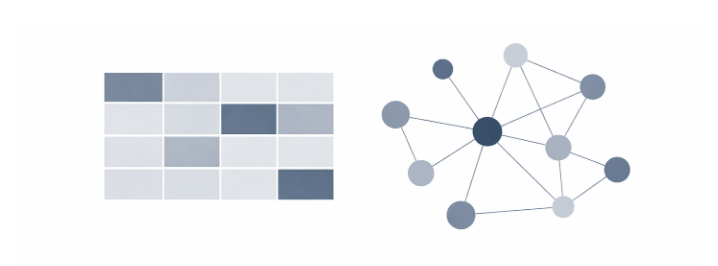
At their core, relational databases store data in tables, organised into rows and columns, similar to a very powerful spreadsheet. Each row is a record such as a customer, an order, or a transaction. Each column is an attribute of that record such as a name, a date, or an amount.
Tables link to each other using keys. For example, to determine which orders belong to which customer, the customer ID is stored in the orders table. At query time, the database follows that reference and combines the tables. This is called a JOIN, and it is the core mechanism that makes relational databases work. As questions become more complex, the number of JOINs increases. This can lead to what is often called join explosion, where the number of intermediate combinations grows rapidly and queries become harder to optimise and slower to run.
SQL databases generally fall into two categories. Transactional databases such as MySQL, PostgreSQL, Oracle, and SQL Server are designed to record individual events quickly while maintaining consistency. Analytical databases, often called data warehouses, such as Snowflake, Redshift, and BigQuery, are designed to run large queries across historical data. Both use tables and SQL.
Relational databases are designed to answer questions about things. How many customers placed orders last month? What is the current stock level? What did this account spend in Q3? These questions have a known shape. You design the table structure to answer them before the data arrives. Where they can struggle is when the question shifts from records to relationships.
How Ally Built a Modern Fraud Intelligence Platform
Learn how Ally applied graph analytics and contextual investigation tools to uncover complex fraud networks and strengthen fraud prevention.
Read Case Study
What is a graph database?
A graph database stores data as nodes and edges. A node represents a thing - a person, an account, a company, a device. An edge represents a connection between two things - owns, transferred money to, is employed by, called. Both nodes and edges can carry properties (a name, a date, an amount).
The critical difference from a relational database is where the relationship lives. In a relational database, the relationship is inferred at query time by joining tables. In a graph database, the relationship is stored directly alongside the data - it exists as a first-class object, not a pointer to be resolved later.
This means following a chain of connections does not degrade in the same way as join-heavy queries. In a relational database, every additional hop in the chain requires another JOIN - and the cost grows with the complexity of the query. In a graph database, following a relationship is a direct traversal, like tracing a line on a map. The database does not need to resolve the relationship at query time; it follows it directly.
Graph databases are relationship-first. They are designed to answer questions about connections: who is connected to whom, by how many steps, through what path, and with what pattern. These are often questions you could not have fully anticipated when you designed the data model.
How do they compare?
| Relational Database | Graph Database | Knowledge Graph | |
|---|---|---|---|
| How data is stored | Rows and columns in tables | Nodes (things) and edges (connections between things) | Nodes, edges, and semantic meaning - entities are typed and relationships are defined in a model |
| Mental model | A spreadsheet with linked sheets | A map of everything and how it connects | A map where every connection has a defined meaning |
| Optimized for | Structured records with known, stable relationships | Data where the connections between things matter as much as the things themselves | Understanding what data means, not just what it contains |
| Starts to struggle when… | You need to follow chains of relationships across many tables | You need to aggregate or count across huge flat datasets | Source data is inconsistent, poorly labelled, or not mapped to the model |
| Best real-world fit | Running the same questions week after week on structured records. If you already know what you're going to ask, this is your tool. | Finding connections you didn't know were there. If the question involves following links across people, accounts, or events, this is where relational starts to break. | Understanding what your data means, not just what it contains. Right for complex enterprise environments where different systems use different labels for the same thing. |
| Typical tools | MySQL, PostgreSQL, Oracle, SQL Server | Neo4j, Amazon Neptune | DataWalk, Stardog, Cambridge Semantics |
| Query language | e.g. SQL | e.g. Cypher, Gremlin, GQL | e.g. SPARQL, Cypher |
How does each database actually work?
Think of a relational database as a set of filing cabinets, each labelled by type - one for customers, one for orders, one for products. Every piece of information goes into the correct cabinet and the correct drawer. To find out which products a customer ordered, you pull the customer drawer, find their ID, go to the orders cabinet, find all orders with that ID, then go to the products cabinet to find what those orders contained. It works well. It is organized. But every question requires visiting multiple cabinets in sequence.
A graph database works differently. Instead of separate cabinets, every piece of information sits in a web of direct connections. The customer node is physically linked to their order nodes, which are physically linked to the product nodes. To answer the same question, you start at the customer and follow the connections - no cabinet-switching, no cross-referencing. The more hops the question requires, the bigger the advantage.
In a well-built graph database, following a relationship is like following a signpost: it is far less sensitive to overall data volume. The relationship does not need to be calculated at query time. It is already there.
One common workaround in relational databases is to collapse multiple tables into one large table to reduce the number of JOINs a query has to perform. It can make certain queries faster, but it means storing the same data in multiple places, and it makes the structure harder to change later. Graph databases do not need this workaround. The relationships are already part of the model.
What type of database should I use?
The clearest signal is the shape of your questions. If your questions are predictable and involve counting, filtering, or summarising records (how many, how much, which ones) a relational database is probably the right fit. Banks, payroll systems, inventory management, and e-commerce platforms all run on relational databases for good reason. The data is structured, the questions are known, and the consistency guarantees that SQL databases provide are essential.
If your questions involve following connections (who is linked to whom, what path exists between two entities, what patterns appear across a network) a graph database becomes the better fit. Fraud detection is the clearest example. A fraud analyst does not just want to know how much money moved through an account. They want to know whether that account shares a phone number with another account that shares a device with three more accounts that all transferred money to the same destination within 48 hours. That is a multi-hop relationship query. A relational database can answer it, but the SQL becomes unwieldy and slow. A graph database answers it naturally.
Other situations where a graph database makes more sense: mapping the connections in a supply chain, finding hidden relationships between people in an investigation, building a recommendation engine, understanding how diseases spread through a population, or detecting anomalies in a network of devices. What these share is that the answer lives not in the data itself but in the pattern of connections between data points.
Which database is faster depends entirely on the nature of the problem you are trying to solve. A graph database asked to sum ten million transaction records will be outperformed by a relational database. A relational database asked to find all entities connected within three degrees of separation across fifty million records will be outperformed by a graph database.
| Requirement / Question Shape | Relational Database (SQL) | Graph Database |
|---|---|---|
| Aggregations (how many, how much, totals) | Strong - optimised for set-based operations | Weak - not primary strength |
| Filtering known attributes (which records match X) | Strong - indexed queries perform well | Moderate - possible but not optimal |
| Predictable, repeatable queries | Strong - schema and queries are stable | Moderate - works but overkill |
| Strict consistency | Strong - mature and reliable | Moderate - varies by implementation |
| Data with fixed structure | Strong - schema-defined | Moderate - flexible but not required |
| Multi-hop relationship queries (paths, connections) | Weak - requires complex JOINs | Strong - native traversal |
| Unknown or evolving questions | Weak - requires query redesign | Strong - flexible exploration |
| Pattern detection across networks | Weak - difficult to express efficiently | Strong - core capability |
| Entity-centric analysis (who is connected to whom) | Weak - indirect via joins | Strong - first-class model |
| Real-time traversal (low-latency path queries) | Weak - degrades with depth | Strong - consistent traversal performance |
| Schema flexibility / evolving relationships | Moderate - changes are costly | Strong - relationships are flexible |
What about platforms like Snowflake and Databricks?
Snowflake and Databricks are cloud data platforms built in the relational and analytical tradition - fast, scalable, and designed to make large datasets accessible to business users without requiring a team of database engineers. Both have invested heavily in blurring the line between OLTP (transactional) and OLAP (analytical) workloads, historically managed by separate systems.
What these platforms do not change is the fundamental challenge of highly connected data. Making a relational system faster or more flexible does not alter the JOIN cost at the heart of multi-hop relationship queries. Graph is not a faster relational database. It is a different answer to a different class of problem - one where the connection is the data, not a pointer to it.
Vendors are converging on a single-platform model: vendors are positioning their platforms as the central place for both storage and analysis. Whether any single platform can genuinely handle transactional, analytical, and relationship-first queries equally well is still an open question. The trade-offs between transactional, analytical, and relationship-heavy workloads remain unresolved.
Learn more
- How DataWalk Compares to Graph Databases, Knowledge Graphs, and Link Analysis Tools - A direct comparison of DataWalk's hybrid architecture against standalone graph databases and knowledge graph products
- Knowledge Graph Software - How DataWalk's unified knowledge graph integrates graph, relational, and AI capabilities into a single analytical platform
- Entity Resolution Software - How DataWalk identifies and links matching records across datasets to create unified entity views without coding -
- Introduction to Knowledge Graphs - A Transformative Approach to Working with Data - A whitepaper on how knowledge graphs differ from relational databases and why they are better suited for complex, interconnected enterprise data -
- Cracking a $5.7M Fraud in 120 Minutes - A case study showing how graph-based investigation resolved a complex fraud case that four weeks of conventional analysis could not


Dr. Michael O’Donnell is a Senior Analyst covering data management strategy, with a particular interest in the gap between data and business value. He tracks the full stack (converged platforms, semantic enrichment, knowledge graphs, data products) is interested in what each gets right, where it stops short, and what that pattern keeps revealing. His measure is simple: can the person who needs the answer get it without an engineer in the middle.
ContactFAQ
Join the next generation of data-driven investigations:
Discover how your team can turn complexity into clarity fast.

Solutions
Product
Partners
Company
Resources
Quick Links