Executive Summary
In the DataWalk expert paper 5 Reasons Why Disparate Data Blocks AI Investigation Agents, Michael Shearer showed that agents pointed at raw, disconnected data miss connections, misread business context and fill gaps with plausible guesses, among other risks.1 Financial institutions are now bringing AI agents into Ultimate Beneficial Owner (UBO) verification, and the same risks exist with those agents.
Financial institutions rarely build ownership structures from scratch. At onboarding, the prospect declares its ownership chain and supplies documents for each beneficial owner. The institution verifies those identities, checks the chain against registries and vendor data such as Moody's Orbis,2 and sums the stakes against the applicable threshold. It is document-heavy, slow and an obvious place for AI agents.
Agents are good at this work: reading documents, checking registries, flagging gaps and drafting inquiries. The KYC system applies the jurisdiction's rules and calculates ownership from the declared chain. Both work from what the prospect submitted. Neither checks what other information the bank might already hold on the companies and people in that chain, and therein lie important risks.
This paper is about appropriately using the internal and external data you already have to ensure that agents are effective in advanced investigations: onboarding reviews where a nominee, an offshore holding or an inconsistent name leaves a gap in the declared chain. Often the bank already holds the missing evidence, because the company behind the gap is an existing customer. The paper follows one prospect, Prospect X, through that review.
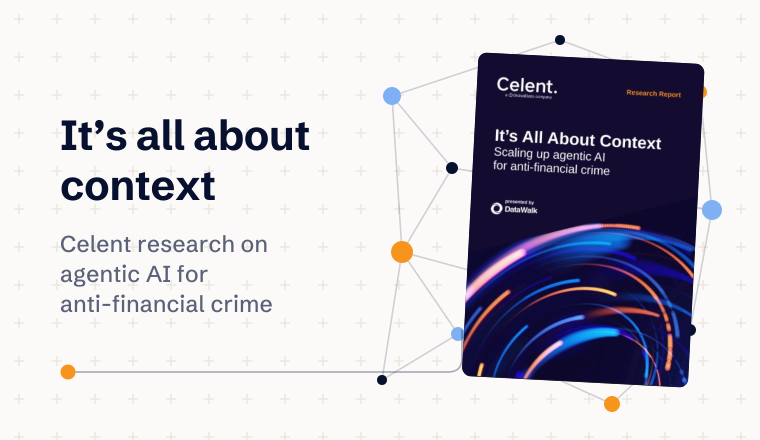
5 Reasons Why Disparate Data Blocks AI Investigation Agents
Set up for scale or introducing new risks?
Get the Whitepaper
The conclusion
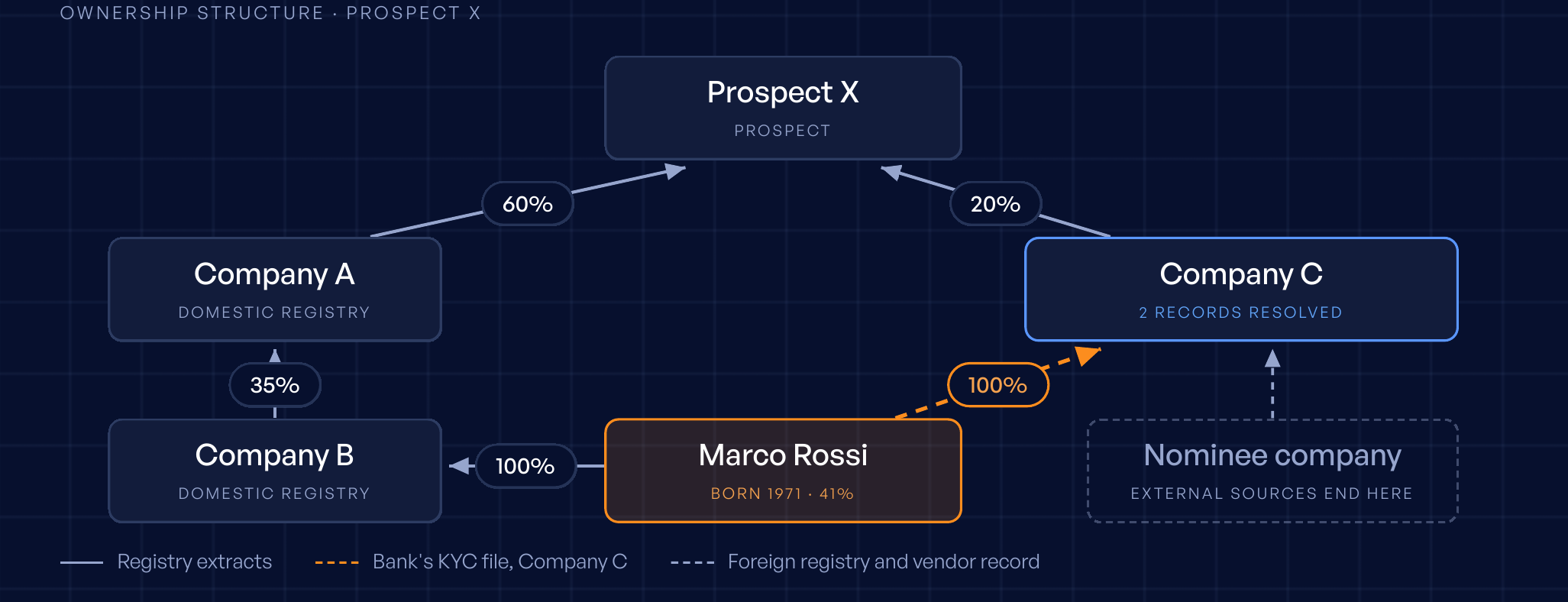
Working from the declaration, registries and vendor data, an agent puts Marco Rossi at 21%, below the threshold. The bank's own file on Company C names him as its owner, which takes him to 41%. DataWalk matches the company and the right Rossi, with evidence, and recalculates every ownership path. The agent then flags the beneficial owner the declaration left out, in a form the investigator can audit.
About the Author
David Tyree is Director, Financial Crime Strategy at DataWalk. A retired DEA Special Agent with more than 25 years of experience investigating money laundering, drug trafficking and transnational organized crime, he has been designated in U.S. Federal Court as a subject matter expert in money laundering. He is a former Chief of Compliance and has taught for ACAMS and the U.S. Department of Justice.

1 Michael Shearer, 5 Reasons Why Disparate Data Blocks AI Investigation Agents, DataWalk (2026): https://datawalk.com/disparate-data-ai-agents-investigations/
2 Moody's and Orbis are trademarks of Moody's Corporation and its affiliates, including Bureau van Dijk. Named for identification only; DataWalk is not affiliated with Moody's.
The Case
An Example: Prospect X at Onboarding
In this paper we are going to consider an example where Prospect X applies to open a corporate account. Its ownership declaration reads:
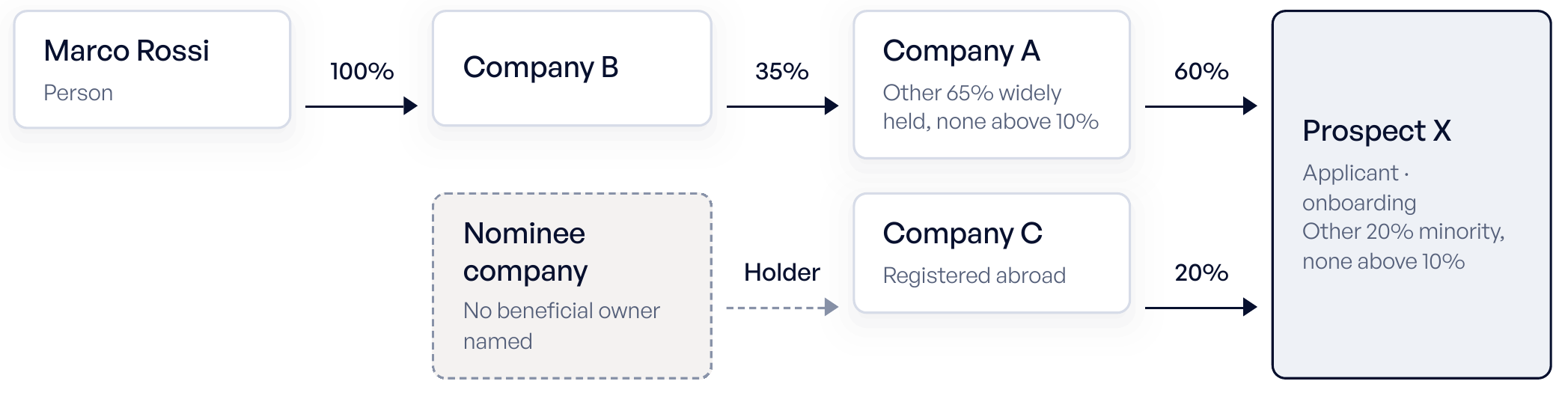
Under both the EU AMLR and the US Customer Due Diligence (CDD) Rule, owning 25% or more, directly or indirectly, makes a person a beneficial owner. Control can too; this case turns on ownership. Multiplying along the chain, Rossi's declared indirect interest is 21%:
100% × 35% × 60% = 21%
Registries and vendor data confirm Companies A and B and show the nominee as Company C's shareholder. The chain for Company C stops there. That is a gap, and the bank challenges it before accepting the prospect.
In reality, the bank's KYC data shows that Company C has been a customer since 2021 and names a Marco Rossi, born 1971, as its 100% beneficial owner. If he is the Rossi in Prospect X's declaration, his combined interest is 41%:
21% through Companies B and A + 20% through Company C = 41%
The challenge is to resolve whether this is the same Marco Rossi and recalculate the full ownership chain in one step, across every path, then give the agent the result. Otherwise, it will be missed and the bank will have drawn an incorrect conclusion about ownership.
The Failure
Where an Agent Without Connected Data Fails
The Prospect X review is given to an agent that can read the onboarding pack and query registries and vendor data, but not the bank's own customer records. It does each task correctly, flags the gap and still reaches the wrong conclusion.
Agent without connected data · Verification result
“Prospect X's declaration is consistent with registry and vendor records. Marco Rossi holds 21% through Companies B and A. Company C's shareholder is a nominee company; its beneficial owner could not be identified from the available sources. No beneficial owner meets the 25% threshold. Recommend an inquiry to Prospect X about Company C.”
Connecting the agent to the bank's customer records does not fix this on its own. The declaration calls the company “Company C Holdings”; the bank holds it under its registered name, “Company C S.à r.l.,” so a search on the declared name returns nothing. The bank also has more than one customer named Marco Rossi, so a name match cannot show which one owns Company C. An agent that settles these questions by reasoning can give two different answers on two different runs. So, in this example we have three common failure modes for an AI agent:
| Failure | In the Prospect X review | |
|---|---|---|
| 1 | Misses connections | Company C's KYC file sits in the bank's customer records, not in the registries or vendor data the agent checks. Searched under the declared name, it does not appear. |
| 2 | Misreads business context | Each source labels the role differently. The foreign registry lists the nominee as “shareholder”; Company C's KYC file records Rossi as “controlling person”; the onboarding form asks for “beneficial owner.” Without the bank's definitions, the agent cannot tell that the file answers the form's question. |
| 3 | Fills gaps with plausible guesses | With no evidence past the nominee, the agent can name a plausible owner, such as the Rossi already in the chain. Even if the guess is right, nothing supports it. |
The KYC system calculates from the declared chain. The 41% depends on a record the declaration never mentions.
The Knowledge Layer
How DataWalk Improves AI Investigations
DataWalk's platform can be inserted as a knowledge layer that complements your existing systems and enables agents to generate more accurate answers. It does not replace the KYC system or the data providers. It adds what neither holds: the bank's own records, connected and resolved.
Filed ownership and precomputed chains, such as Moody's Orbis. Here, they confirm Companies A and B and the nominee.
Holds the declaration, applies the jurisdiction's rules and calculates ownership from the chain it is given.
Connects the bank's records, resolves entities across them and returns the evidence for each match.
Reads the submission, checks each declared link for evidence, reports gaps and drafts inquiries.
In our example, DataWalk's entity resolution matches the declared “Company C Holdings” to the bank's “Company C S.à r.l.” on registration number and registered address. It matches the Rossi in Company C's file to the Rossi in the declaration on date of birth and residential address, and keeps him apart from a retail customer of the same name born in 1985.
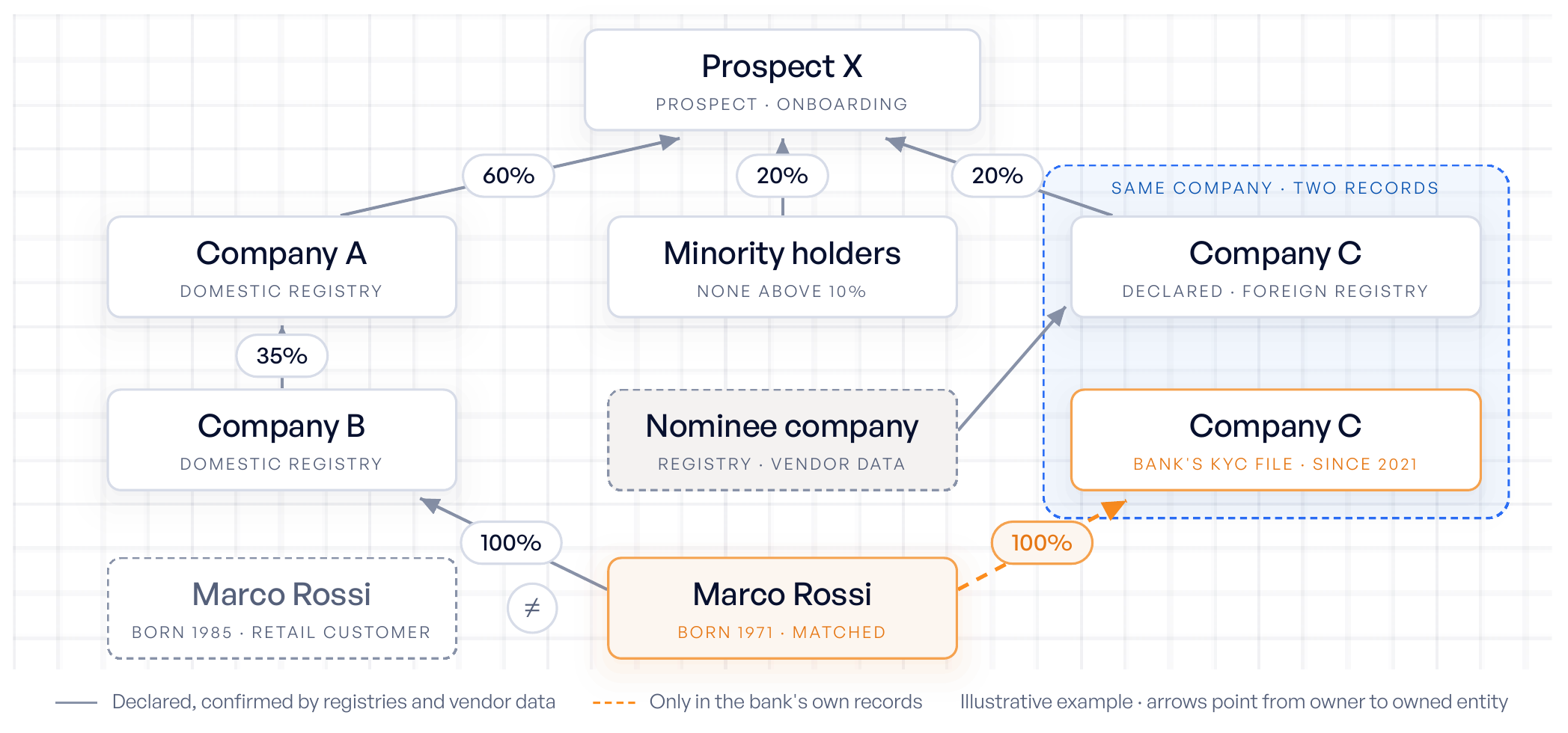
With both matches made, Rossi has a second path to Prospect X. Each layer of evidence gives a different answer:
Rossi holds 35% × 60% = 21% through Companies B and A.
Companies A and B are confirmed. Company C ends at the nominee.
Company C's KYC file names Rossi as its 100% owner, bringing him to 21% + 20% = 41%.
The Agent's Role
Who Does What in the Ideal Review
With DataWalk as the knowledge layer, the agent does not search for the ownership structure. It checks whether there is evidence for each association the prospect declared, and hands each step to the system suited to it.
| Step | In the Prospect X review | Done by | |
|---|---|---|---|
| A | Spot the gap | Checks each declared link for supporting evidence. Company C's chain ends at a nominee with no beneficial owner. | AI Agent |
| B | Search the bank's records | Finds Company C among existing customers and confirms the match on registration number and registered address, despite the different name. | DataWalk |
| C | Compare | Sets the bank's file (Rossi, 100% beneficial owner) against the declaration (nominee, no owner named). | AI Agent |
| D | Resolve Marco Rossi | Matches the Rossi in Company C's file to the Rossi in Prospect X's declaration on date of birth and residential address. Excludes the other customers of the same name. | DataWalk |
| E | Complex recalculation | Recalculates every path from Rossi to Prospect X under the applicable rules, including the one through Company C: 21% + 20% = 41%. | DataWalk |
| F | Flag | Reports the discrepancy, its source and its consequence to the investigator, linked to the match evidence and source records DataWalk keeps. | AI Agent |
The agent reasons; the matches and the arithmetic do not depend on it. With the same data and rules, every step returns the same result, and a reviewer can trace how each was reached.
The Report
What the Investigator Receives
With DataWalk as the knowledge layer, the agent's report for Prospect X could read:
Agentic AI · Discrepancy report
“Prospect X's declaration gives Marco Rossi, born in 1971, a 21% interest through Companies B and A. It names no beneficial owner for Company C, which holds 20%. Company C is an existing customer, and its KYC file names Rossi as its 100% beneficial owner. Including that interest brings his ownership to 41%, above the 25% threshold.
“The declared Company C Holdings was matched to the bank's customer Company C S.à r.l. on registration number and registered address. Rossi was matched on date of birth and residential address; the retail customer of the same name born in 1985 was excluded.
“Rossi is therefore a beneficial owner of Prospect X and must be identified, verified and screened. Confirm that Company C's KYC file is current. A draft inquiry asks Prospect X to name Company C's beneficial owner and explain why Rossi's interest through it was not declared.”
Conclusion
Before Letting an AI Agent Investigate
AI agents can take much of the manual effort out of UBO verification at onboarding and later on: reading documents, checking registries, flagging gaps and drafting inquiries. The KYC system calculates ownership from the declared chain.
The finding that mattered in Prospect X was not in the declaration or the registries. It was in the bank's own file on Company C. Reaching it took two matches the agent could not make reliably on its own: the company under a different name, and the right Marco Rossi. DataWalk made both, with evidence, then recalculated every ownership path through the chain to reach 41%.
With DataWalk as the knowledge layer, the agent can utilize any or all of the bank's internal and external data about a prospect's ownership, with the evidence to check it. DataWalk works alongside your existing systems and data providers to enable your agents to generate better results. Without it, these failure modes become failures in your UBO investigations.
Before implementing the UBO AI investigation workflow, ask:
- Which declared links do our sources leave without evidence?
- Does the review check what the bank already holds on each company and person in the chain?
- Can we explain every entity match and reproduce the result?
- Are missing information and conflicting sources clearly recorded for follow-up?
- Can an investigator open the evidence behind each finding?
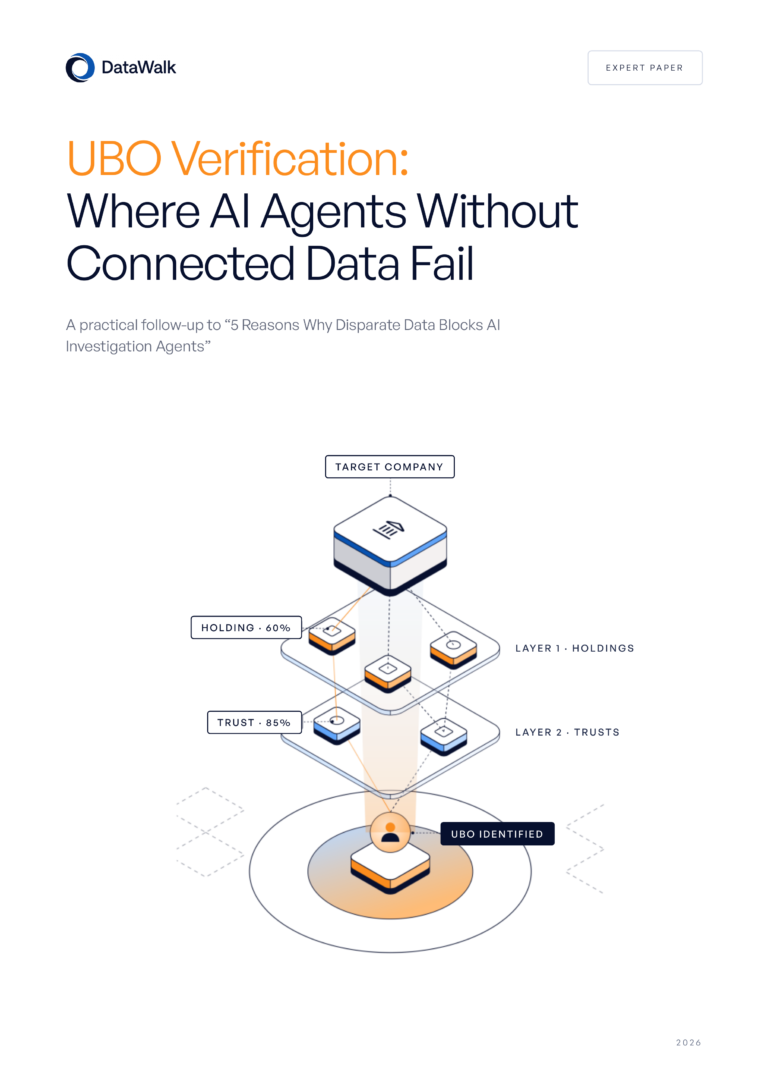
UBO Verification: Where AI Agents Without Connected Data Fail
This paper is about appropriately using the internal and external data you already have to ensure that agents are effective in advanced investigations: onboarding reviews where a nominee, an offshore holding or an inconsistent name leaves a gap in the declared chain.
Get the PaperDataWalk Platform
See DataWalk in action
Request a personalised live demo and discover how DataWalk connects the dots across your data.