

Palantir Products and Competitors: Alternatives to Gotham and Foundry
Why this guide
Organizations evaluating Palantir alternatives often ask similar questions about products, costs, and the competitive landscape. Below you’ll find clear, skimmable answers — plus where DataWalk fits.
Introduction
Palantir Technologies is a global leader in data, analytics & AI, offering robust software solutions and services tailored to both governmental and commercial sectors. Among its flagship products are Palantir Foundry and Palantir Gotham, each designed for distinct use cases, with Apollo and AIP recently introduced as complementary platforms.
While Palantir maintains a very strong position in defense, intelligence, and large government programs, a growing set of competitors are offering alternative solutions, often with different cost structures and more flexible implementation models. Let’s explore these Palantir competitors and understand why platforms like DataWalk are gaining traction as viable alternatives.
Palantir Gotham
What Is Palantir Gotham?
Palantir Gotham is an operating system for global decision‑making widely used by governmental, law enforcement, and military agencies for tasks like intelligence analysis, law enforcement investigations, national security, and battlefield operations. Gotham’s ability to integrate massive amounts of structured and unstructured data into a unified model makes it a critical tool for organizations managing complex investigative workflows.
Although primarily deployed in government and defense settings, Gotham has also been used in a handful of commercial projects, mainly in banking and financial services. Gotham has become a go‑to solution for large agencies requiring robust analytics capabilities, but its high costs and customization demands have opened the door for competitors offering similar features with greater flexibility and affordability.
How much does Gotham cost?
Palantir’s own price list (corroborated by an analysis of publicly available GSA Schedule data) shows that an annual Gotham license for a single server core costs about US $88,171, with annual support and maintenance of around US $28,722 per core1 . Projects typically require many cores and extensive professional services, so deployments can run into tens or hundreds of millions of dollars. Palantir’s government contracts illustrate the scale: a five‑year expansion of the Army’s Project Maven was valued at US $480 million2 and a modernization of the Army’s Distributed Common Ground System awarded to Palantir and BAE reached US $823 million3.
Who competes with Gotham?
When it comes to investigative analytics, Palantir's Gotham has historically competed with custom-built solutions from integrators and tools like Harris i2, SAS Visual Investigator, BAE Systems NetReveal, and others. These vendors provide link analysis and intelligence workflows that provide a subset of Gotham's capabilities. DataWalk frequently emerges as a leading alternative in this space because it delivers comparable large-scale data integration and investigation-oriented tools at a significantly lower cost.
Today, however, Palantir is increasingly positioning Gotham as a broader operations system or battlefield operating system. This shifts the competitive landscape, making it harder to define. For investigative analytics, the competitors mentioned above remain relevant. But for defense and operations, competition instead comes from large-scale command, control, and intelligence platforms custom-built by major defense contractors, such as Lockheed Martin, Northrop Grumman, and Raytheon. The definition of "competition" therefore strongly depends on the specific use case.
It's also worth noting that when analyzing open-source or internet sources, you may encounter additional solutions that market themselves as "Palantir alternatives." Many of these are:
- Point solutions for smaller organizations: These tools mainly emphasize search, visualization, and link analysis. They are not focused on building extensible platforms, adding custom functionality, performing entity resolution/MDM, or managing broad data integration.
- Complementary rather than alternative tools: These are often positioned for specific niches like OSINT enrichment or visualization.
- Broader technology players with overlapping claims: Service providers, data lakehouse vendors, graph analytics platforms, enterprise software vendors, and data science environments may all compete with parts of Palantir’s offering — but rarely with the full, end-to-end stack of capabilities.
Examples across these categories include Harris i2 Analyst’s Notebook, Siren, Linkurious and some other OSINT, Crypto and search-based solutions that might be considered as supplemental. While powerful in their domains, they are generally not enterprise-class alternatives to Palantir Gotham, but rather focused point solutions or complementary technologies.
Federal Police Agency Sees Spectacular Results with 10-week DataWalk Project
Learn More >>>
Palantir Foundry
What Is Palantir Foundry?
Palantir Foundry is a data management and analytics platform designed to address the complex challenges of integrating, organizing and analyzing massive amounts of data. Foundry stands out for its ability to transform raw data into actionable insights by creating an ontology‑driven architecture. This architecture unifies disparate datasets into a shared language, allowing organizations to align their data with their operational workflows.
How much does Foundry cost?
Foundry is positioned as a platform to build custom applications. The cost of Foundry reflects this flexibility: a Forrester Total Economic Impact study commissioned4 by Palantir found that a composite global enterprise incurred about US $82.1 million over three years5 in Foundry software licenses, associated cloud costs and Palantir professional services. In practice, individual contracts vary widely but often involve tens of millions of dollars for software and services, while major public contracts for Palantir’s platform have topped hundreds of millions6.
Who competes with Foundry?
In the broader data-platform market, Palantir Foundry is often compared with Databricks, Snowflake, AWS Lake Formation, Google Cloud, Microsoft Fabric (Azure Synapse), Informatica, Alteryx, and SAS. These platforms provide data integration, ontology building, and analytics capabilities that overlap with Foundry’s features. However, these platforms generally favor analytics-centric workloads, while Palantir is typically used for real-time operational workloads and analysis, offering bidirectional integration with source systems. Another core differentiator is Foundry’s domain-specific, out-of-the-box ontologies. While the vendors listed above provide robust tools for building ontologies, they rarely deliver pre-built, domain-focused ontologies, which are central to Foundry’s positioning as an ontology-driven data integration and analysis platform.
Because of these distinctions, it’s difficult to capture all possible alternatives in a single framing. In the context of pure data integration and analytics platforms, the vendors mentioned above remain the most relevant competitors.
Palantir Apollo
What Is Palantir Apollo?
Palantir Apollo is a platform for managing deployment and operations of Palantir’s software (including Gotham and Foundry). It is designed to automate software updates, compliance and scaling across environments.
Apollo uses a hub‑and‑spoke architecture: hub environments receive information and telemetry about spoke environments and issue plans to make changes, while each spoke reports information and telemetry back to the hub. Palantir’s documentation notes that before announcing a platform change, telemetry is written to identify impacted resources. This architecture facilitates automated updates but means customers must enable telemetry reporting; for organizations whose compliance or security policies prohibit sending operational telemetry outside their network, this requirement can be problematic.
Sovereignty note: Apollo’s update model relies on environment telemetry for orchestration. Many defense programs require no outbound connectivity from classified or air-gapped networks. Organizations with such constraints often prefer platforms that can be updated and governed without external telemetry or vendor-managed hubs.
Palantir AIP
What Is Palantir AIP?
Palantir AIP is a layer that integrates large language models and other AI tools with Palantir’s existing platforms. It can automate basic data tasks, such as importing datasets or summarizing information.
Basic features (e.g., dataset import and summarization) are available “out‑of‑the‑box,” but the documentation notes that more complex integrations and workflows generally require input from engineers or development teams, and user feedback suggests that many advanced integrations require direct assistance from Palantir engineers. AIP is interoperable with both Gotham and Foundry.
DataWalk: An Alternative in Intelligence Analysis and Investigations
For the purposes of this document, we'll focus on the Intelligence Analysis and Investigations category — the space where DataWalk most directly competes with Palantir’s offering. Many organizations attempt to replicate Palantir's capability by stitching together a costly patchwork of vendors (data integration platforms, graph tools, visualization tools, etc.). DataWalk is notable as an off-the-shelf solution that provides this full-spectrum capability without the multi-vendor complexity and friction, offering both platform flexibility and investigation-oriented analytics at a significantly lower cost. Unlike generic data platforms, DataWalk is optimized for integrating and analyzing highly connected big data for applications in:
- Commercial sectors: Banking, insurance, e-commerce, oil & gas, and telecommunications.
- Government ministries and departments: Requiring broad data fusion and analysis.
- Law Enforcement Agencies (LEA) and Intelligence Agencies: Conducting criminal, financial, and counter-terrorism investigations.
- Defense organizations: Requiring situational awareness and intelligence fusion.
Deployment Modes (Defense/IC): Open networks, classified networks, and fully air-gapped environments — with no mandatory telemetry, no forward-deployed engineers, and full operational sovereignty on commodity hardware.
The Unique Position of DataWalk
Within the commercial segment of this category, other notable competitors include SAS (specifically SAS Visual Investigator) and Quantexa. Both focus heavily on fraud, AML, and customer intelligence use cases, but unlike DataWalk, they do not extend meaningfully into defense, law enforcement, or national intelligence domains.
In this landscape, DataWalk stands out as the only hybrid “build and buy” alternative. It combines the affordability and speed of an off-the-shelf product with the extensibility of a true enterprise platform, designed for investigative and intelligence analysis across both commercial and government sectors.
Three Categories of Palantir Competitors In Intelligence Analysis And Investigations
When considering alternatives to Palantir Gotham and Foundry for intelligence data analysis and investigative use cases it's helpful to categorize them as follows:
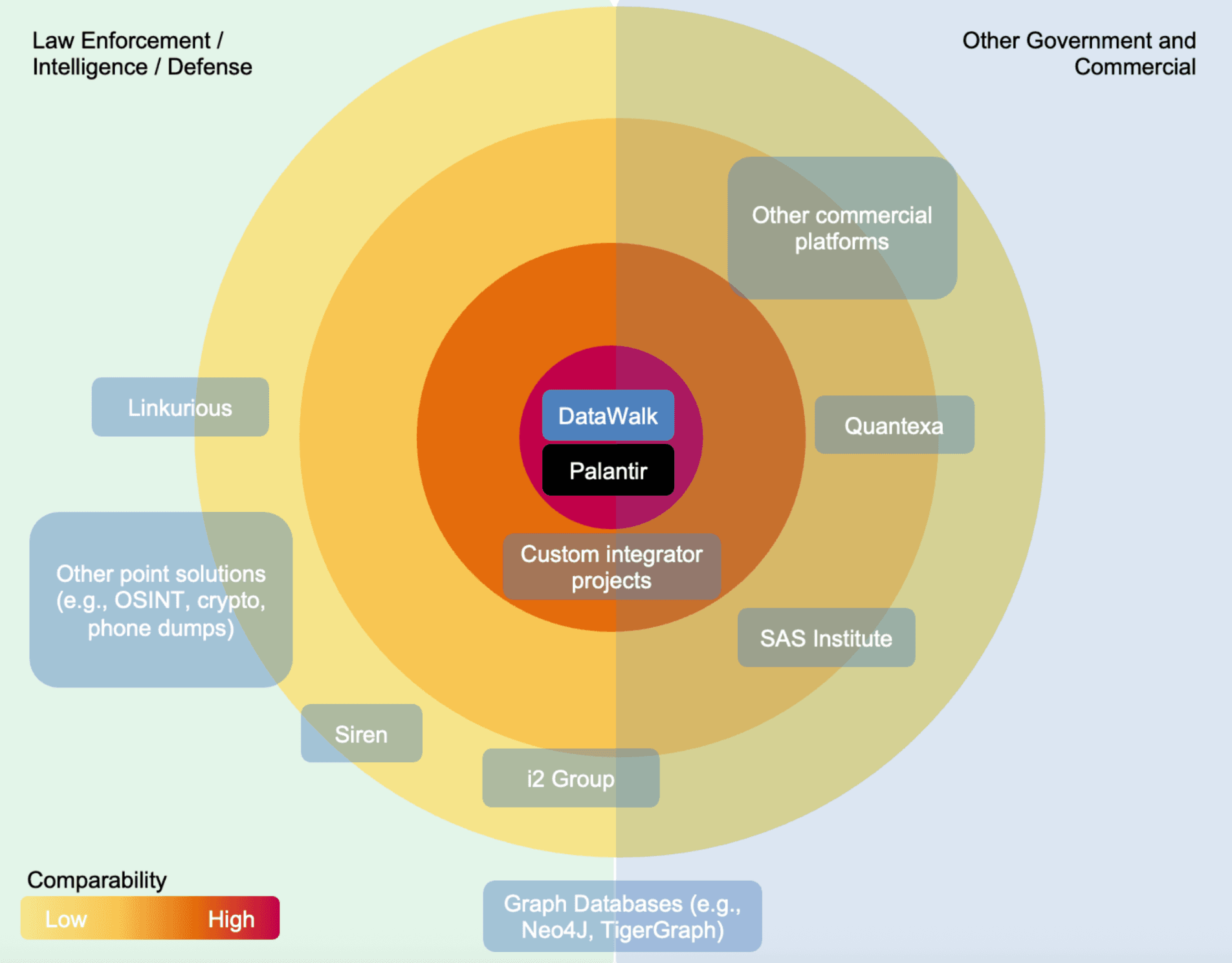
Figure 1: Bullseye of Palantir alternatives and related data analysis tools for “finding bad guys” scenarios. DataWalk is the closest full-scale alternative. Inner rings represent platforms for large organizations, while the outermost ring shows point solutions that only have a niche scope. Vendors outside the bullseye are supplementary platforms, not true alternatives to Palantir.
Small‑Scale Solutions for Basic Needs (Outer Rings)
Many Palantir competitors position themselves as alternatives to Palantir Gotham & Foundry but, in reality, fall far short. Some of these tools offer only a small fraction of Palantir's capabilities (e.g., search and visualization) and are only sufficient for meeting the basic requirements of smaller organizations.
However, when it comes to integrating many datasets or sources, cleaning data, performing complex analyses on millions/billions of records, automating processes, adhering to IT/compliance requirements or expanding the platform capabilities—like integrating your own LLMs or AI models—these solutions often fail to deliver. Their limited functionality makes them unsuitable for organizations with more demanding needs or large‑scale operations.
Custom‑Built Solutions by Customers or Integrators (Inner Rings)
Some customers and system integrators develop bespoke solutions tailored to their unique needs as an alternative to Palantir Gotham and Foundry. While these custom-built systems can meet specific requirements, they often involve enormous development and maintenance costs—sometimes hundreds of millions of dollars—and take years to complete, with a very high risk of failure.
Additionally, several vendors deliver black‑box solutions where critical mechanisms are hidden and coded into the system. As a result, customers may not have full visibility into the rules and processes used to identify suspicious events, leaving them without complete control over how the system operates.
Enterprise-Class Composable Platforms (Inner Rings & Bullseye)
Palantir competitors in this category are enterprise-class software solutions that bridge the gap between solution and platform capabilities. DataWalk, a prime example of this category, demonstrates competitive breadth across multiple domains, including Graph Analytics, Intelligence Analysis, and Data Science Platforms.
These platforms offer:
- Comprehensive solution features – a wide array of out‑of‑the‑box capabilities that require no custom coding, only configuration, to meet business needs efficiently and effectively.
- Platform flexibility – extensible capabilities that enable cost‑effective scalability and adaptability, allowing seamless system expansion as organizational requirements evolve.
Such a hybrid solution stands out by delivering similar features with greater flexibility and affordability. Its lower costs and the absence of custom development requirements make it an attractive choice for organizations looking for powerful, scalable and budget‑friendly alternatives to Palantir Gotham and Foundry.
Why DataWalk Is a Powerful Enterprise-Class Alternative
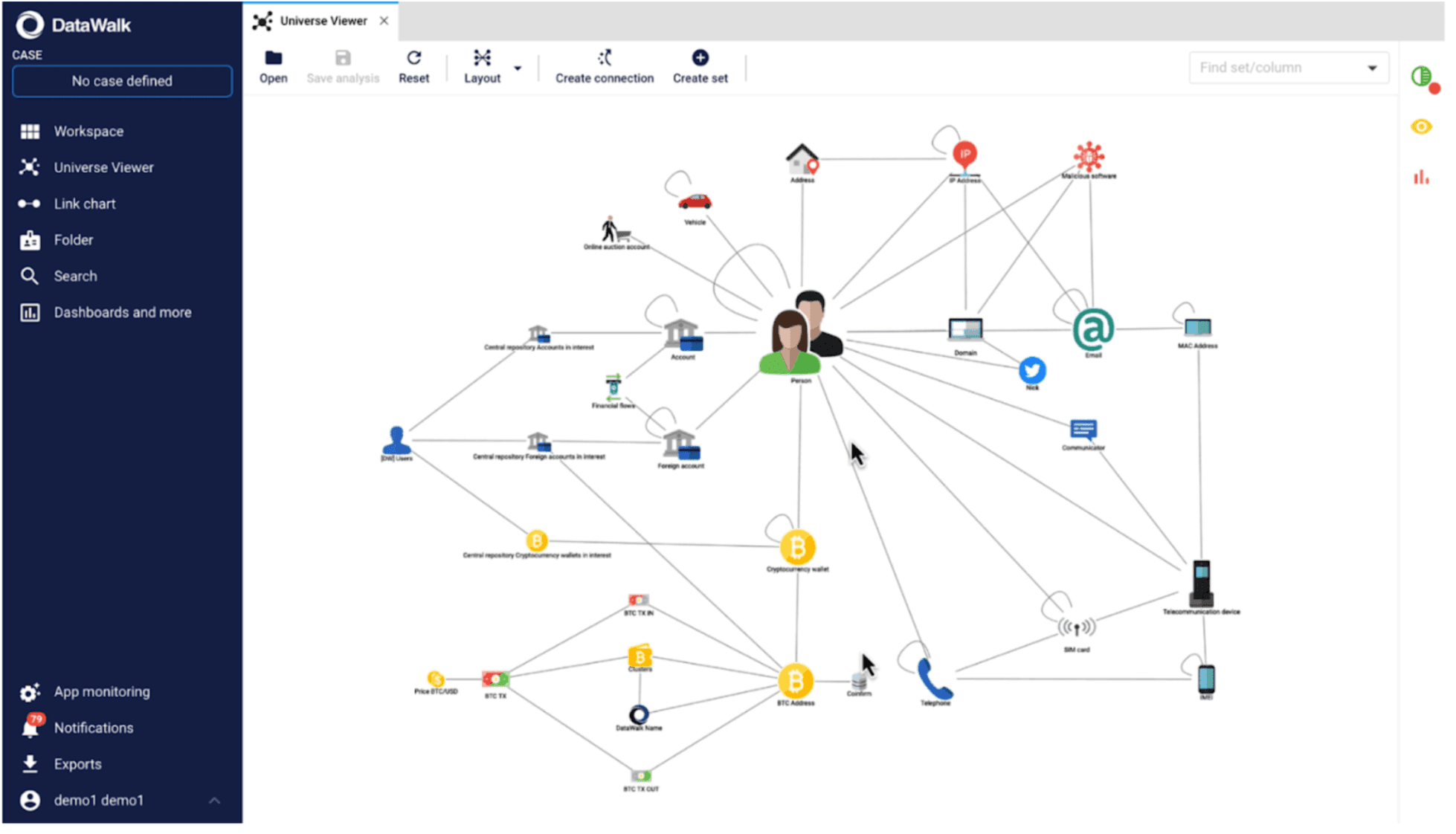
Figure 2: DataWalk’s “Universe Viewer” — the visual representation of your ontology and knowledge graph.
Ontology & Data Integration
Palantir highlights the importance of ontologies to organize and connect data at scale. While Palantir offers out-of-the-box, which may limit flexibility for organizations with highly customized data models. DataWalk counters with a platform built for flexibility and open standards. It uses an ontology-first, no-code knowledge graph that easily adapts to evolving missions without lock-in. DataWalk is purpose-built to seamlessly adapt to your organization's existing ontology or to empower your teams to create a new, customized model rapidly, ensuring fast time-to-value. This agility also extends to ontology expansion: Automated source-to-ontology mapping converts structured and unstructured inputs directly into action-ready intelligence, reducing the need for extensive manual modeling.Low-Code/No-Code Intelligence
Modern enterprise intelligence platforms must empower non-technical users to conduct complex investigations and create analyses independently. DataWalk's graphical, no-code environment delivers this necessary self-service capability by reducing dependence on engineering teams. The platform provides the operational freedom required for rapid investigation and analysis creation, mirroring the utility and speed of Palantir's tools like Contour or Quiver. This ensures mission-critical work can be executed immediately, without extensive engineering involvement.Architecture
DataWalk employs a unique architecture (read more: here) designed to minimize data movement by keeping all analytics — complex queries, graph algorithms, OLAP, ML, and geospatial — within a single-state database. Analysts can perform multi-hop, explainable analyses across large datasets in real time. Crucially, DataWalk is engineered for openness and zero vendor lock-in. Customers can combine the power of DataWalk’s investigative analytics and fast computations with their existing data stores (e.g., Oracle™ or Neo4j™) and popular visualization tools (e.g., Power BI™, Tableau™) without forced migration, ensuring maximum control over their data ecosystem.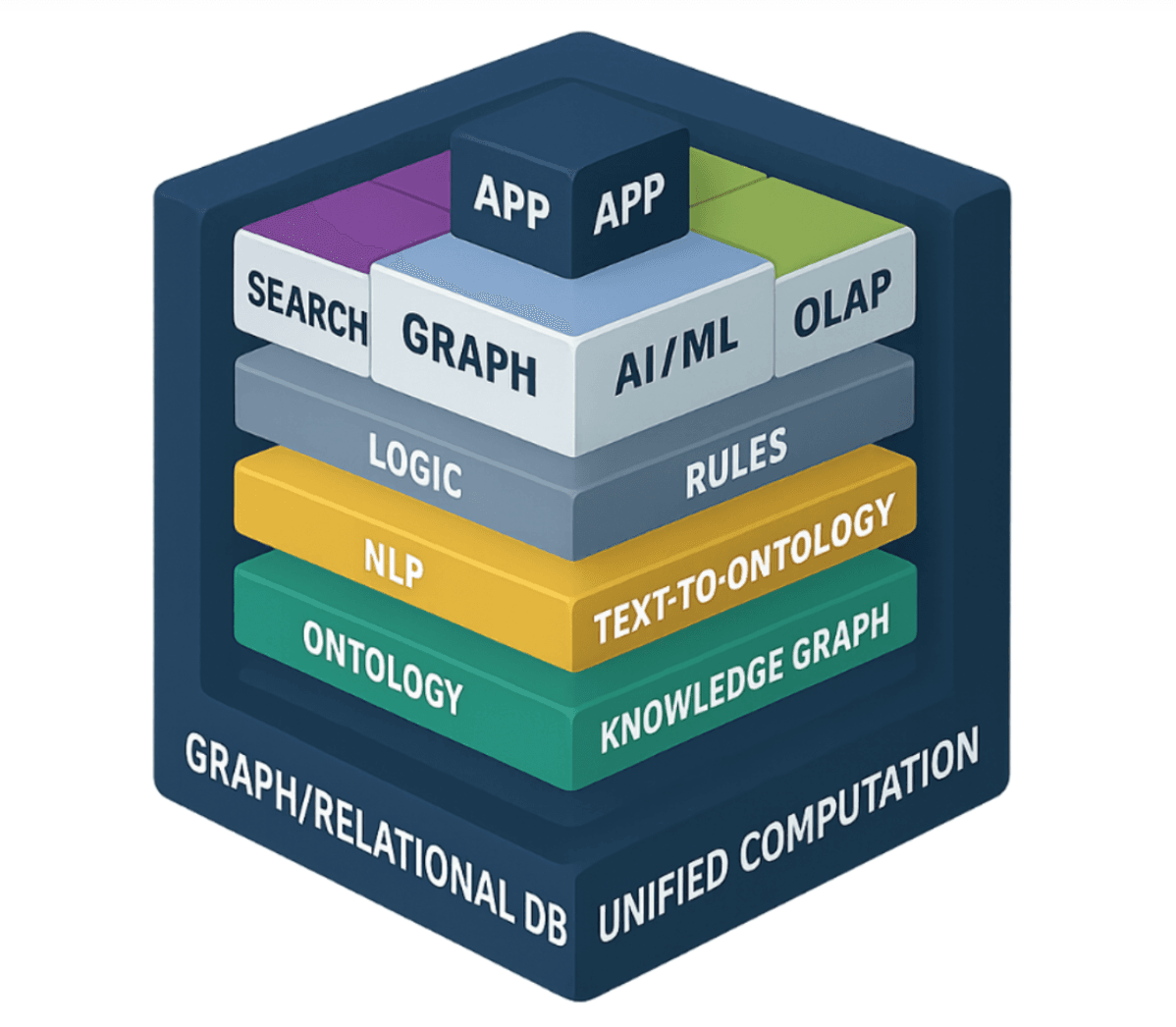
Figure 3: DataWalk Composite AI components within a single computation and database layer.
Analytics / Composite AI
Composite AI is the integration of multiple AI techniques into a single platform to improve efficiency, broaden knowledge representation, and solve complex problems more effectively. DataWalk delivers this natively by unifying machine learning, graph analytics, NLP, rules-based reasoning, and LLM integration around a central knowledge graph and inference engine. This architecture continuously refreshes derived insights, scales to massive datasets, and supports secure, enterprise-grade deployments across commercial, government, and defense environments. Unlike fragmented toolkits, DataWalk’s Composite AI is fully integrated—enabling explainable, high-performance analytics with full auditability, operational sovereignty, and extreme agility to adapt to evolving missions.Read more: DataWalk Composite AI: Unified Enterprise AI for Intelligent Business Solutions >>>
Privacy, Security and Control
With DataWalk, customers retain full ownership of their data and analyses. DataWalk follows a commercial off-the-shelf model that is implemented and run entirely by the customer. This ensures they retain maximum control while enabling unmatched agility to adapt the system as needs evolve—without waiting on vendor timelines. Organizations gain full transparency into how the system operates, own the code and workflows they build, and can run fully on-premises if desired — without mandatory telemetry or external dependencies.Agility and Cost
Palantir emphasizes deployment speed. DataWalk matches this through its streamlined deployment capabilities while delivering comparable investigation-focused capabilities with a predictable licensing model. Beyond deployment, DataWalk empowers organizations to remain agile as their needs evolve — the platform accepts data as-is without extensive preparation, making it easy to incorporate new sources, extend use cases, and rapidly adapt to changing requirements, all while maintaining enterprise-grade security and compliance. Its single-platform licensing model provides a transparent, predictable investment structure at significantly less cost than Palantir.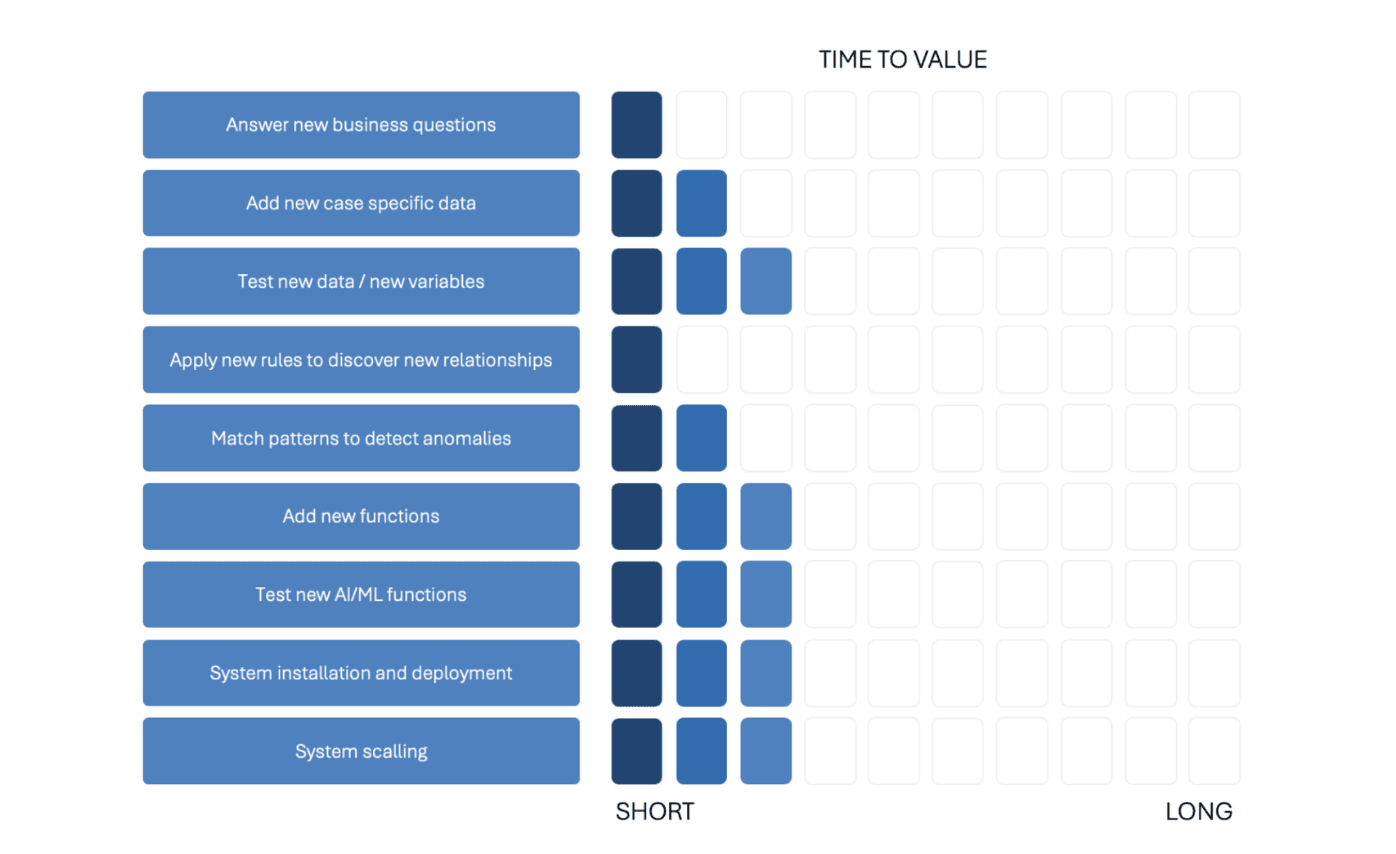
Figure 4: The figure illustrates how DataWalk enables organizations to quickly answer new questions, add data, test variables, discover relationships, and apply new functions — including AI/ML — without extensive preparation. This ability to accept data as-is ensures streamlined deployment and ongoing agility, allowing teams to rapidly adapt to evolving requirements while maintaining enterprise-grade security and compliance.
Self-Managed and Secure by Design
Both platforms are built with governance and compliance in mind. DataWalk is engineered to deliver full functionality in open networks, classified environments, and fully air-gapped systems. It can be run on commodity hardware by internal teams, with military-grade, cell-level access controls that ensure users only see what they are cleared to see, with full auditability.Adoption Across Governments and Industries
Palantir and DataWalk are both trusted by defense, intelligence, and law enforcement organizations worldwide. Agencies use DataWalk to reduce data preparation time, fuse structured and unstructured sources into knowledge graphs, and support mission-critical decisions. Its pricing model offers transparency, and the platform is designed to be operated without long-term reliance on embedded vendor teams.Beyond government, DataWalk is actively used across industries:- Financial Services: Supporting AML, KYC/CDD, fraud detection, threat intelligence, and risk assessment.
- Fortune 500 Corporations: Enabling insider threat detection, supply chain risk management, and due diligence.
- Commercial Sector: Applied in e-commerce, retail, energy, and ride-sharing/delivery to improve resilience and operational insight.
By integrating emerging technologies like generative AI, DataWalk has automated unstructured data analysis, extended functionality to include text transcription and object detection, and significantly accelerated investigations.
Conclusion
The landscape of Palantir competitors is diverse, ranging from lightweight point solutions to costly custom-built systems. For organizations considering Palantir Gotham, the alternatives often fall between building a bespoke solution with long timelines, high cost and high risk, or adopting an enterprise-class platform that delivers investigative analytics out of the box. For those evaluating Palantir Foundry, alternatives typically include large-scale data platforms that provide integration and analytics capabilities but often require significant engineering investment.
DataWalk represents a different path. It combines the speed and cost-effectiveness of an off-the-shelf product with the extensibility of a true enterprise platform. This hybrid “build and buy” approach minimizes time-to-value while enabling organizations to configure, extend, and integrate the platform to their unique needs without vendor lock-in.
Widely trusted by government agencies, defense organizations, financial institutions, and commercial enterprises, DataWalk delivers mission-ready functionality with transparent pricing, operational independence, and scalability across use cases. DataWalk's proven ability to perform across these diverse sectors — including complex mandates for a major Federal Government Agency — validates its enterprise-class stability and capability to replace high-end, bespoke systems.
Whether applied to law enforcement, intelligence, financial crime, or commercial operations, DataWalk enables teams to achieve results quickly while retaining the flexibility and control required in enterprise-class analytics.
1. Palantir software and support pricing document
2. Palantir wins contract to expand access to Project Maven AI tools
3. Palantir, BAE score $823M contract to modernize Army’s Distributed Common Ground System
4. Forrester Consulting. (2023). The Total Economic Impact™ of Palantir Foundry. Palantir Technologies.
5. The Total Economic Impact™ Of Palantir Foundry
6. Capoot, A. (2024, May 30). Palantir wins $480 million AI computer vision deal with US Army. Bloomberg
Table of contents
- Why this guide
- Introduction
- Palantir Gotham
- Palantir Foundry
- Palantir Apollo
- Palantir AIP
- DataWalk: An Alternative in Intelligence Analysis and Investigations
- Three Categories of Palantir Competitors In Intelligence Analysis And Investigations
- Why DataWalk Is a Powerful Enterprise-Class Alternative
- Conclusion
Join the next generation of data-driven investigations:
Discover how your team can turn complexity into clarity fast.

Solutions
Product
Partners
Company
Resources
Quick Links